
Landscape
Located in the Touraine region, between the banks of the Cher and Loire rivers, on clay-limestone soils.
In the heart of the Loire Valley châteaux region, in the commune of Saint-Martin-le-Beau, the estate extends across 18 hectares.
Our vineyard is predominantly south-facing, following a succession of sloping hillsides that stretch from the left bank of the Loire to the right bank of the Cher.
This configuration provides a climate particularly well suited to viticulture and the ripening of the grapes.
The plateau between the two rivers reaches its highest point in the Forest of Amboise at 108 metres above sea level, while the right banks of both the Loire and the Cher lie at elevations of around 50 metres.
.jpg)

.jpg)


Terroir
The Montlouis vineyard is established on soils derived from several geological formations: 39% dating from the Quaternary period, 25% from the Tertiary, and 36% from the Secondary (Mesozoic) era.
Our topsoils are composed of clay and flint from the Senonian period, sometimes mixed with Eocene deposits and, above all, alluvial sandy materials, more or less blended with wind-borne sands.
What truly defines the uniqueness of our terroir, however, is the subsoil into which the roots of the Chenin Blanc vines extend. Tuffeau limestone—also known as Turonian chalk or limestone—dominates the underground strata, imparting both elegance and character to our wines.
This predominantly clay-siliceous and clay-limestone composition allows our vines to make the most of the sun’s warmth, which is absorbed during the day and gradually released at night by the flint-rich soils.
The nature of the subsoil is a key asset in regulating the supply of water and minerals, helping to prevent excessive water stress while promoting balanced vine growth—ideal conditions for producing great Chenin Blanc wines.


Pruning marks the beginning of the year in the vineyard. It is a time for observation and reflection.
Although the days are long and the conditions can sometimes be challenging, it is also the moment when our connection with the vine grows stronger.
During pruning, we observe the flow of sap, minimize wounds to the wood, and carefully select the buds to be retained.
A well-executed pruning not only influences the upcoming harvest but also the following year's crop, while contributing to the longevity of the vine.
We also strive to maintain a balanced level of vigor throughout our vineyards.
To achieve this, we occasionally apply our own composts whenever the vine’s needs require it.


With the return of spring and the first signs of the vine awakening, the pace begins to intensify.
Bud rubbing allows us to refine the work carried out during pruning, while tractors resume their rounds through the vineyards for soil cultivation and any necessary treatments.
Next come shoot positioning, leaf thinning, and, depending on the needs of the vintage, some green harvesting.
Then, little by little, the activity slows down.
The vine continues its development and reminds us that sometimes, it is important to know how to wait.

The estate's wines are aged in troglodyte cellars carved out of local stone: tufa.
The constant temperature is between 13 ° and 14 ° which is favourable to the aging of the wines and allows the thermal self-regulation of the barrels during the alcoholic fermentation.
The grapes from each of the plots are pressed and vinified separately.
The wines are aged in Allier oak barrels or in stainless steel vats for 6 to 24 months depending on the vintage.
They are then bottled and labelled in the cellar.


Harvest
Throughout the growing season, ripeness assessments allow us to determine the ideal time to harvest each vineyard plot.
When the grapes have reached optimal maturity, the harvest can begin.
Our two straddle tractors, equipped with bins, continuously transport the buckets filled by the harvesters, ensuring a perfectly coordinated operation.
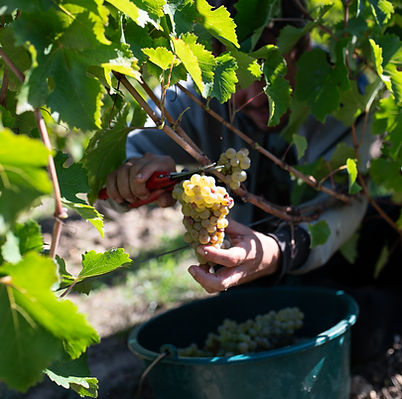
At the estate, all grapes are harvested by hand.
For two to three weeks, a team of around 25 pickers and carriers joins our permanent staff, providing valuable support during this intense yet essential period.
This meticulous work, carried out in the vineyards throughout the year, enables the grapes to fully express their identity.
Harvested at peak ripeness, they reveal the full richness of the soils and climates from which they originate.
Our role then continues in the cellar, where we strive to preserve this quality and authenticity so that each wine faithfully reflects the character of its terroir.
.jpg)
.jpg)
.jpg)
.jpg)
.jpg)
.jpg)
.jpg)
.jpg)
.jpg)
.jpg)


.jpg)
.jpg)
.jpg)
.jpg)
.jpg)
.jpg)
.jpg)

